Japanese appliances are built for 100V. UK sockets supply 230V, more than double that. Plug a Japanese rice cooker, kettle or hair dryer into a UK socket with nothing more than a plug adapter and it will be getting 2.3 times the voltage it was designed for. At best it trips. At worst it burns out the heating element or the circuit board in seconds.
The fix is a step-down converter that takes 230V in and gives a steady 100V out. This guide covers how to check whether your appliance needs one, how to size it properly, the frequency question nobody mentions, and which converter suits which appliance.
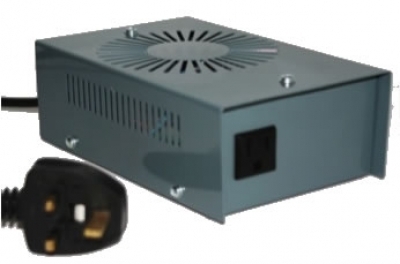
Japan vs UK electricity at a glance
| Japan | UK | |
|---|---|---|
| Mains voltage | 100V | 230V (nominal, often 240V at the socket) |
| Frequency | 50Hz in the east (Tokyo, Sendai), 60Hz in the west (Osaka, Kyoto, Nagoya) | 50Hz |
| Plug type | Type A (two flat pins) and Type B (two flat pins plus earth) | Type G (three rectangular pins, fused) |
Two things need solving: the plug shape and the voltage. A plug adapter solves the first one only.
Plug adapter or voltage converter: which do you need?
Turn the appliance over or look at the charger and find the rating plate. It tells you everything.
- It says "100-240V" (or "AC100-240V"). The appliance is dual voltage. Phone chargers, laptop power bricks, camera chargers and most games console power supplies fall into this group. You only need a Japan to UK plug adapter. No converter.
- It says "AC100V" only. The appliance is single voltage and needs a 230V to 100V step-down converter. This covers most Japanese kitchen appliances, rice cookers, kettles, hair dryers, massage chairs, toilet seats, karaoke machines and a lot of audio equipment.
If the label is in Japanese only, look for the figures. 100V and the wattage (W) are printed in Western numerals on almost every Japanese rating plate.
Why a plug adapter on its own is dangerous
A plug adapter is just a shaped piece of plastic and metal. It changes nothing electrically. A 100V appliance on 230V draws far more current than it was designed for, so heating elements overheat, motors run too fast and electronics fail. Many of the "Japan to UK adapter" listings on marketplaces are plug adapters only, and a common way Japanese appliances end up damaged in the UK.
The 240V to 100V step-down transformer (often searched as a 230V to 100V step down transformer) is the part that actually makes the appliance safe to use.
How to size your Japanese voltage converter
Converters are rated in VA (volt-amps). For everyday appliances you can treat watts and VA as roughly the same thing. Find the wattage on the rating plate, then add headroom:
- Heating appliances (rice cookers, kettles, hair dryers, hot plates): choose a converter rated at least 25% above the appliance wattage.
- Motors and compressors (blenders, mixers, massage chairs, fridges, vacuum cleaners): allow two to three times the running wattage, because motors draw a surge when they start.
- Electronics and audio (amplifiers, record players, keyboards): add 25% and consider an isolating model if you are sensitive to hum and noise.
- Several appliances on one converter: add the wattages together, then add the headroom.
Example: an IH rice cooker rated at 1,200W needs at least 1,500VA. A 700W standard rice cooker sits comfortably on 1,000VA.
| Appliance | Typical rating | Suggested converter |
|---|---|---|
| Phone or laptop charger (100-240V) | n/a | No converter, plug adapter only |
| Turntable, small audio, clock radio | Under 50W | 50VA to 100VA |
| Stereo amplifier, keyboard | 100W to 200W | 250VA to 500VA |
| Standard rice cooker | 500W to 700W | 750VA to 1,000VA |
| IH or pressure rice cooker | 1,000W to 1,400W | 1,500VA to 2,000VA |
| Kettle, hair dryer | 1,200W to 1,300W | 1,500VA to 2,000VA |
| Massage chair, washlet toilet seat | Check the plate, motors surge | 2,000VA to 3,000VA |
These figures are typical ranges. Always size from the wattage printed on your own appliance.
The frequency question: 50Hz vs 60Hz
A transformer changes voltage. It does not change frequency. UK mains is 50Hz, the same as eastern Japan, so appliances bought in Tokyo will behave exactly as they did at home.
Appliances bought in western Japan were designed for 60Hz. Most modern Japanese appliances are marked 50/60Hz on the rating plate and work on either. If yours says 60Hz only:
- Heating appliances (kettles, hot plates, hair dryers) are not affected.
- Electronics with a switch-mode power supply are not affected.
- Mains-synchronised clocks and timers can run slow, and some motors (turntables, fans) run around 17% slower.
- Some rice cookers have a 50Hz/60Hz switch underneath. Set it to 50Hz.
Autowound or isolating: which type?
Airlink builds both types of Japan to UK converter, and the right one depends on what you are plugging in.
- Autowound converters use a single winding, which makes them smaller, lighter and better value. They are the standard choice for kitchen appliances, hair dryers and general household use. All of our autowound Japan to UK converters conform to EN61558-2-13 and are CE and RoHS compliant.
- Isolating converters use separate input and output windings with no direct electrical connection between them. That adds a layer of electrical safety and filters out a lot of mains noise, which is why they are preferred for hi-fi, studio and sensitive electronic equipment. The UK-JA0250-Iso is our isolating model for audio kit.
The Airlink Japan to UK converter range
Every converter in the range takes 230V UK mains in and gives a 100V output. Plug-in models come with a UK 13A plug and Japanese 3-pin sockets, so your appliances plug straight in without adapters. Models from 750VA upwards have two Japanese sockets.
| Model | Rating | Max output current | Best for |
|---|---|---|---|
| UK-JA0050 | 50VA | 0.5A | Clocks, turntables, small electronics |
| UK-JA0100 | 100VA | 1A | Audio, small kitchen gadgets |
| UK-JA0250 / UK-JA0250-Iso | 250VA | 2.5A | Amplifiers, keyboards, hi-fi (Iso) |
| UK-JA0500 | 500VA | 5A | Standard rice cookers, coffee machines |
| UK-JA0750 | 750VA | 7.5A | Rice cookers, mixers |
| UK-JA1000 | 1,000VA | 10A | Rice cookers, toasters |
| UK-JA1500 | 1,500VA | 15A | IH rice cookers, kettles, hair dryers |
| UK-JA2000 | 2,000VA | 20A | High-wattage kitchen kit, massage chairs |
| UK-JA3000 | 3,000VA | 30A | Multiple appliances, large motors |
For permanent installations such as a full Japanese kitchen, a restaurant or a commercial machine, there are hardwired models up to 6,000VA, including 200V output versions (UK-JA4200HW and UK-JA6002HW) for Japanese equipment built for 200V supplies. Every unit is built and tested in the UK and comes with a one-year warranty.
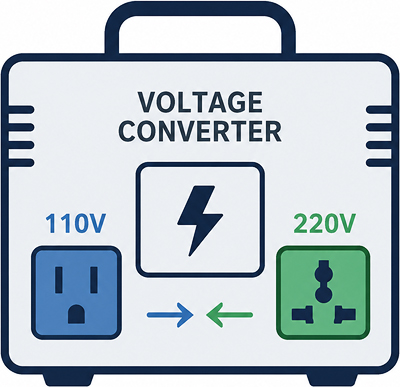
Browse the full range of Japanese voltage converters, or see the UK-JA1000 1,000VA converter, the most popular size for rice cookers.
Going the other way? UK appliances in Japan
If you are moving to Japan and taking UK appliances with you, you need the opposite: a step-up converter that takes 100V and gives 230V. See our UK to Japan voltage converters.
Safety checklist before you switch on
- Check the rating plate says 100V and note the wattage.
- Choose a converter with at least 25% headroom, or two to three times for motors.
- Do not daisy-chain extension leads between the converter and the appliance.
- Keep the converter ventilated. It is normal for it to feel warm under load.
- Switch the converter off at the wall when it is not in use for long periods.
- Buy from a manufacturer that builds to EN61558 and fits proper overload protection.
Related guides: voltage converters and how to choose a voltage converter.
Frequently asked questions
Can I use a Japanese rice cooker in the UK?
Yes, with a 230V to 100V step-down converter. Check the wattage on the base, add at least 25%, and choose a converter at or above that figure. Most IH rice cookers need 1,500VA.
Is a Japan to UK plug adapter enough?
Only for dual-voltage items marked 100-240V, such as phone and laptop chargers. Anything marked AC100V only needs a voltage converter as well.
What size transformer do I need for 240V to 100V?
Take the appliance wattage and add 25% for heating appliances or allow two to three times for motors. For several appliances, add their wattages together first.
Will a Japanese kettle work in the UK?
Yes, through a converter of around 1,500VA. A kettle is a pure heating load, so frequency makes no difference.
Does a voltage converter change 60Hz to 50Hz?
No. A transformer only changes voltage. Most Japanese appliances are marked 50/60Hz and work fine on UK 50Hz. Clocks, timers and some motors built for 60Hz only can run slow.
Can I leave a converter plugged in all the time?
Yes. An off-load converter draws very little power. For long periods without use, switching it off at the wall is good practice.