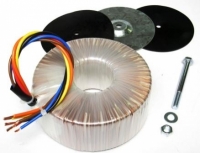
A toroidal transformer is a transformer wound on a ring-shaped (doughnut-shaped) core. The copper windings wrap evenly all the way round the ring instead of sitting on one leg of a square stack of steel plates. That simple change in shape makes toroidal transformers smaller, lighter, quieter and more efficient than traditional laminated transformers of the same power, which is why they are the first choice for audio amplifiers, lighting, medical equipment and control panels.
This guide explains how they work, where they beat laminated transformers and where they do not, and exactly what to specify when you buy one.
How a toroidal transformer works
Every transformer has the same three parts: a primary winding that connects to the supply, one or more secondary windings that feed the load, and a steel core that carries the magnetic field between them. The ratio of turns between primary and secondary sets the output voltage.
In a toroidal transformer the core is made from a continuous strip of grain-oriented silicon steel, wound tightly into a ring like a roll of tape. The primary and secondary windings are then wound around the ring, covering it completely. Because the magnetic path is a closed loop with no joints or air gaps, very little of the field escapes and very little energy is lost.
Toroidal vs laminated (EI) transformers
The traditional alternative is the EI transformer, built from stacked E-shaped and I-shaped steel laminations. Here is how the two compare.
| Toroidal | Laminated (EI) | |
|---|---|---|
| Size and weight | Often up to half the size and weight for the same VA | Larger and heavier |
| Stray magnetic field | Very low, because the windings cover the whole core | Higher, which can induce hum in nearby circuits |
| Mechanical hum | Very quiet | Laminations can buzz under load |
| Efficiency | High, with no air gaps in the core | Lower, with losses at the lamination joints |
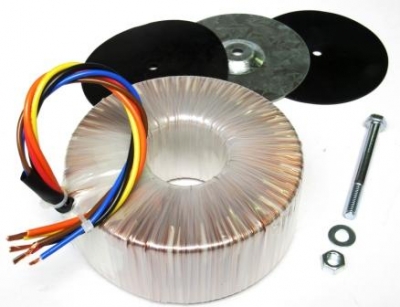
| Mounting | Single centre bolt with rubber pads and a steel washer | Four-corner bracket mounting |
| Switch-on surge | Higher inrush current | Lower inrush current |
| Price | Usually a little more per VA | Usually a little less per VA |
Advantages of toroidal transformers
Smaller and lighter
The efficient ring core means less steel and less copper for the same power. In tight enclosures, rack equipment and anything portable, that saving matters. On autowound toroidal models the size and weight reduction compared with an EI design can reach 30% to 70%, depending on the secondary voltage.
Low magnetic interference
With the windings spread evenly over the whole core, the magnetic field stays inside the transformer. That is why toroidal transformers are the standard choice in hi-fi and studio amplifiers, where stray fields show up as audible hum, and in medical and measurement equipment where interference affects readings.
Quiet running
There are no loose laminations to vibrate, so a well-made toroidal transformer is near silent under load. For audio, home cinema and anything used in a quiet room, that is a real benefit.
Efficient and cool
Lower losses mean less wasted energy and less heat, which helps reliability and keeps enclosures cooler. Airlink designs every toroidal transformer to Class A insulation (105°C), with a maximum temperature rise of 50°C above ambient.
Disadvantages to plan for
Toroidal transformers are not perfect for every job, and a good supplier will tell you where to be careful.
- Inrush current. When a toroidal transformer is switched on, it can draw a very large current for a fraction of a second, which can exceed 50A. That can trip a standard miniature circuit breaker. Use a Type D or motor-rated MCB, a slow-blow fuse, or a soft-start (surge limiter) module.
- Cost. Winding wire through a closed ring takes more specialist machinery than slotting coils onto an EI stack, so toroidal units often cost a little more per VA.
- Mounting. The centre bolt must not form a closed loop through the chassis. If the bolt touches metal at both ends it acts as a shorted turn. Always use the supplied rubber pads and washer, and never let the bolt bridge to the case at the top.
Where toroidal transformers are used
- Audio: hi-fi amplifiers, studio equipment, valve amps and balanced power units.
- Lighting: low-voltage halogen and LED lighting, stage and architectural lighting.
- Medical and laboratory: equipment where low leakage current and low interference matter.
- Industrial controls: control panels, PLC power supplies and instrumentation.
- Marine and leisure: isolation and voltage conversion on boats and in vehicles.
- Voltage conversion: autowound toroidal transformers for running 115V equipment on 230V, and the reverse.
How to choose a toroidal transformer
Work through these six points and you will have everything a manufacturer needs to quote or to find the right model off the shelf.
- Power rating (VA). Multiply the output voltage by the output current: volts × amps = VA. Add a margin of around 20% so the transformer is not running flat out.
- Primary voltage. 230V for UK and European mains, 115V for US equipment, or a dual 115V/230V primary if the product ships worldwide.
- Secondary voltage and windings. Specify the output voltage and whether you need one winding or two. Two windings (for example 2 × 18V) can be wired in series for a centre-tapped supply or in parallel for double the current.
- Isolating or autowound. Isolating transformers have separate primary and secondary windings for electrical safety. Autowound transformers use one shared winding and are a smaller, cheaper way to step between 230V and 115V when isolation is not needed.
- Shielding and protection. For audio and medical work, ask for an electrostatic (Faraday) screen between windings and a steel band to reduce stray fields further. A built-in thermal fuse or push-to-reset breaker protects against overload.
- Mounting and terminations. Choose the mounting kit (rubber pads and washer, or an epoxy-potted centre for a single bolt), the lead length, and whether you want bare leads, crimped connectors or terminal blocks.
Standard range or custom build?
Airlink holds a standard range of more than 350 chassis mounting toroidal transformers from 30VA to 6,000VA, covering the common secondary voltages with single and dual windings. If one of those fits, it is the fastest and best-value option.
If you need a non-standard voltage, an unusual footprint, a specific lead length or a certificate to a particular standard, we design and manufacture custom toroidal transformers in the UK. Every transformer is 100% tested before it leaves us, including a 3,000V RMS hi-pot test between primary and secondary, and is built to BS EN 61558 using oxygen-free copper wire.
Browse the chassis mounting toroidal transformers range, see the standard range, or request a custom quote.
Related guides: toroidal technical notes and using dimmer switches with toroidal transformers.
Frequently asked questions
Why are toroidal transformers better for audio?
Their closed ring core keeps the magnetic field contained, so they induce far less hum in nearby audio circuits. They also run quietly and regulate well under the changing loads of an amplifier.
Can I replace an EI transformer with a toroidal one?
Usually, yes. Match the primary voltage, secondary voltage and VA rating, check there is room for the round footprint and a centre bolt, and make sure the supply fusing can handle the higher switch-on surge.
Why does my toroidal transformer trip the breaker when I switch on?
That is inrush current. Use a Type D or motor-rated breaker, a slow-blow fuse, or fit a soft-start surge limiter.
Do toroidal transformers work on 50Hz and 60Hz?
Yes. Airlink toroidal transformers are designed for 50/60Hz, so they work in the UK, Europe and the USA. A transformer does not change the frequency.
How do I work out the VA rating I need?
Multiply the secondary voltage by the current you need, then add about 20%. For example, 24V at 5A is 120VA, so a 150VA transformer is a sensible choice.
What do the wire colours on a toroidal transformer mean?
On Airlink transformers the 230V primary is blue and brown. Secondary colours are listed on each product datasheet.